
Russia's unprecedented rapprochement with North Korea has raised concerns about the re-emergence of a Russia-China-North Korea alliance which could increase the probability of conflict on the Korean Peninsula, explains Dr Rajaram Panda.

At the summit, India signed the SCO's memorandum of obligations, kick-starting the process of its accession into the group as a full member.
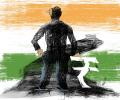
Expect a more modest out-turn of around 5 per cent (if not less) because of the longer-term scarring effects of the Covid shock, the sharply slowing growth in the pre-Covid years and some scepticism about the growth-efficacy of some of recent official policy initiatives, explains Shankar Acharya, former chief economic advisor to the government.

"We often thought of terrorism as a peripheral problem for this region. The barbaric terrorist strikes in Paris, Ankara, Beirut, Mali and on the Russian aircraft is a stark reminder that its shadow stretches across our societies and our world, both in recruitment and choice of targets," Modi said in his remarks at the East Asia Summit.

As India strives to make its Act East Policy a comprehensive politico-diplomatic and economic success, Brunei gains more salience, says Dr Rahul Mishra.

India will look to play a key role in the APEC, EU and Africa regions to increase its competitiveness.
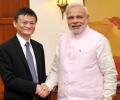
Alibaba's pervasive economic and social influence in China is seen as a threat to the authority of the Chinese Communist party, notes Shyam Saran.

Modi said India will continue its support to ASEAN for a rules-based security architecture for the region.
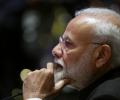
'It seems a wiser decision to pull out at the right moment than regret after joining the pact,' explains Dr Rahul Mishra.
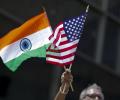
India has demanded resumption of export benefits to certain domestic products under GSP, and greater market access for its products from sectors like agriculture, automobile, auto components and engineering. On the other hand, the US wants greater market access for its farm and manufacturing products, dairy items and medical devices, data localisation, and import duties cut on some ICT products.

Called the US Citizenship Act of 2021, the legislation modernises the immigration system, and also proposes to eliminate the per country cap for employment-based green cards, a move that would benefit thousands of Indian IT professionals whose current wait period for legal permanent residency runs into several decades.

Reports (not denied by India) that the USA had 'for the first time provided real-time details to their Indian counterparts on the Chinese positions and force strength in advance of a PLA incursion' into Tawang at the LAC in December 2022, helping India thwart China's expansionist designs, show how operationally effective the USA-India friendship has become on the ground. A engaging excerpt from Sreeram Chaulia's must-read new book, Friends: India's Closest Strategic Partners.

By hosting the 10 ASEAN leaders on Republic Day, India amply demonstrated that ASEAN is a central pillar of its Act East policy. But is India 'central' for ASEAN, asks Dr Rahul Mishra.
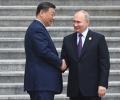
"The two sides note that the relationship between Russia and China has progressed to a more advanced interstate cooperation compared to the military-political unions of the Cold War era as it is not bloc or confrontational in nature, nor does it target any third countries," Russia's new agency Tass quoted the document as saying.

Trade between India and Indonesia stands at $20 billion.
The success of the Bali Ministerial meeting of the World Trade Organisation in the first week of December in 2013 will mean that in 2014 countries will identify areas for early conclusion so that within the next two years, the Doha Agenda of the WTO -- which has remained in a limbo for long -- can be concluded.
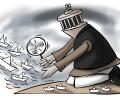
The report by the High Level Advisory Group said India stands to benefit even more when the US and China are locked in a global trade war.

"We work with other countries to develop their capabilities and support their efforts to make free sovereign choices. More broadly, we aim to advance peace and stability in the region," he asserted.

'What India needs to do is to re-build those cultural links in a way it didn't.' 'Clearly, India needs to wake up and spend more time on ASEAN.'
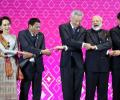
The prime minister also welcomed convergence of views between India and ASEAN for cooperation in the Indo-Pacific region.

Prime Minister Narendra Modi has met his Australian counterpart Scott Morrison in Washington, DC, ahead of the first in-person Quad meeting to be hosted by US President Joe Biden and discussed a broad range of issues of bilateral, regional and global importance, including the Indo-Pacific.

Whether it is Sri Lanka, Maldives, or Nepal, quietly but steadily, India has been reclaiming some of the ground it had lost to China, observes Aditi Phadnis.

India and China ties are likely to enter into a "new age of cooperation" especially in trade in view of Prime Minister Narendra Modi's knowledge of Chinese investment promotion and his plans for economic reforms, according to an official think-tank in Beijing.

President Pranab's four-day visit to China that saw him meeting the top Chinese leadership and discussing the sticky boundary issue and cooperation in combating terrorism besides the need for a predictable nuclear regime.
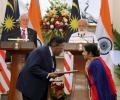
Considering the common linkages, high-level trust, complementarities, and convergent interests between the two nations, Malaysia has the potential to become India's key partner in Southeast Asia, says Dr Rahul Mishra.
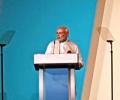
"In the flux and transition of our times, the most critical need in this region is to uphold and strengthen the rules and norms that must define our collective behaviour," he said.
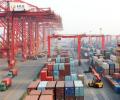
Modi will have limited choice other than stressing upon a request for more time to decide on tariff rates, especially with elections in 2019.

The two leaders discussed the Ukraine crisis and several regional and global issues including increasing trade relations and cooperation in the field of mitigating the impact of climate change during their bilateral talks at the Danish Prime Minister's official residence in Mareinborg near Copenhagen.

During the meeting on the sidelines of the 11th BRICS Summit on Wednesday, prime minister Modi said there was a "new direction and new energy" in bilateral ties after the two leaders' second informal summit in Chennai.

The high point of the trip will be Goyal's meeting with US Trade Representative Robert Lighthizer on November 13, which is expected to see the USTR push India towards lower import duties in a broad range of areas.
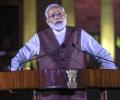
The reshuffle could take place before the start of the winter session of Parliament.
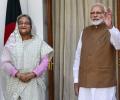
The pacts signed after Modi-Hasina talks provided for deeper cooperation between the two countries in areas of water resources, youth affairs, culture, education and coastal surveillance.
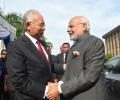
Both countries will advance maritime security and strengthen disaster response in the region, says Modi.

'The two sides agree to continue firmly supporting each other in safeguarding their respective core interests,' a joint statement issued at the end of Muizzu's talks with Chinese leaders said.
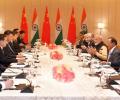
China had been trying hard to enter the Indian market, without opening its own to Indian products. There is an economic crisis in India-China relations that the Chennai Connect barely scratched the surface, points out Srikanth Kondapalli.

Their favourite alternatives: Malaysia, Vietnam and the Philippines. Note, India is missing from that list. And this is despite an attractive financial incentive scheme for OSAT players. The reason, said a senior executive of a US chip company who had a meeting in Taiwan just a few weeks ago, is that "they want more predictability in government policy because they plan to put in big money."
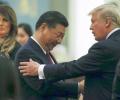
'While many Chinese policy makers dismiss the political, economic and technological component of US-India relations, they express caution on the defence-related ties which also happens to be a major driver in US-India relations,' explains China expert Srikanth Kondapalli.

Thailand expressed interest in the Indian defence industry and its experience and expertise in the field of defence R&D and production. Modi welcomed Thai investments in India in the potential areas under the 'Make in India' initiative, especially in the manufacturing sector, infrastructure development, tourism and hospitality facilities.

'Keeping Kashmir out of the informal summit does not mean that they have given up their strategic interest.'

Modi attended the 20th ASEAN-India Summit in Jakarta. Secretary-General of ASEAN Dr Kao Kim Hourn also attended the summit.
